This issue of the newsletter features a draft excerpt from my upcoming work, “Attack on Freedom” (進擊的自由). This article was written last December—a piece of over ten thousand words reflecting on my experiences pursuing information freedom over the past twenty years. What follows is just a small selection.
At the moment of writing, Jimmy Lai, the founder of Next Digital, had just been found guilty of three national security charges.
I still remember the end of last year; after attending the sentencing of the 47 pro-democracy activists, I found it impossible to sleep. Early the next morning, I simply got out of bed and headed back to the West Kowloon Magistrates’ Courts. In the wind and rain, I vied for a spot against the professional “line-standers” just to observe the trial of the Apple Daily national security case.
As soon as the court opened, the defense lawyer asked Jimmy Lai about his original intention for founding Next Digital. Mr. Lai replied that media promotes the flow of information; the more information one possesses, the more free one becomes. Thus, after the June 4th incident, he decided to found Next Magazine. He spoke with such nonchalance, yet hearing those words—unprepared as I was—made my skin crawl.
It wasn’t that the words were exceptionally moving. Quite the opposite: this discourse has become dated. If Mr. Lai hadn’t brought it up, I would have forgotten it entirely. Born in the era of the internet and smartphones, I witnessed information move from scarcity to expansion to total saturation. I can understand the context of that era. But for Gen Z, who have never “searched for data” and have only ever “swiped through posts,” these words might sound like “the more air there is, the smoother your breathing will be”—it doesn’t quite hold up to scrutiny. If more information made people freer, shouldn’t we have been free long ago? Why, then, do we still lack even universal suffrage?
Yet, Mr. Lai’s view at the time of the newspaper’s founding was absolutely correct. Information carries knowledge, facts, data, and the ability to discern right from wrong. Without information, one cannot fight for freedom, nor even know if freedom exists; fundamentally, the very concept of freedom cannot take root. Information freedom is the foundation of freedom of speech, personal freedom, freedom of belief, freedom of association, and all others. Information is like the forbidden fruit of Eden: one bite ensures you are no longer “domesticated,” liberating all subsequent possibilities while forcing you to bear a heavy price.
Thinking of this, the 1995 television advertisement for the launch of Apple Daily—the image of Mr. Lai hit by multiple arrows yet still calmly eating an apple—surfaced vividly in my mind, sending a shiver through me.
The Three Walls Obstructing Information
In the Japanese manga Attack on Titan, there are Nine Titans, each with distinct traits. The “Attack Titan,” hosted by the protagonist Eren Yeager, is characterized by its relentless pursuit of freedom throughout its life. The “Founding Titan,” also inherited by Eren, possesses the power to rewrite memories and control all other Titans (except the Attack Titan).
If we replace “Titans” with “Freedom,” then information freedom is the protagonist of this ensemble drama—playing the crucial role of “Attack on Freedom,” while also serving as the “Founding Freedom” from which all other layers of freedom derive.
By the same logic, the most direct way to restrict a citizen’s freedom is to block the flow of information. Coincidentally, much like the Maria, Rose, and Sina walls that kept the Titans at bay, the primary means of obstructing information also comes from three high walls.
from Attack on Freedom
Many friends know I am a massive fan of Attack on Titan. Even the title of my new work, Attack on Freedom, and its core imagery, are unabashed tributes to it.
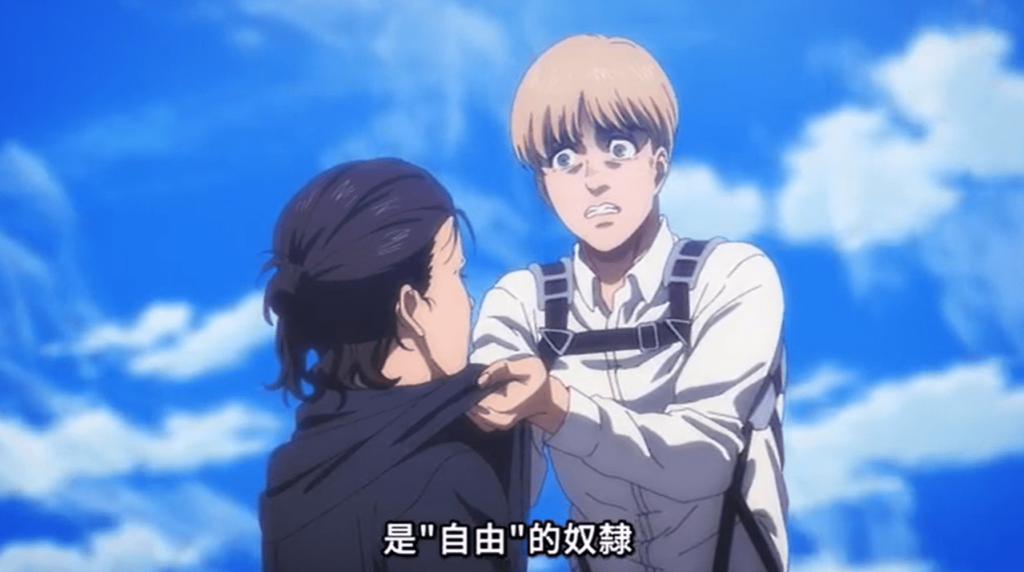
Beyond Hajime Isayama’s brilliant plotting and profound characterization, fans of the series would likely agree that the dialogue is exceptionally well-crafted, embedded with many iconic lines. The one that left the deepest impression on me was the scene where the protagonist, Eren, mocks himself as a “Slave to Freedom.”
I’ve watched Attack on Titan over and over. I always understood this phrase—composed of a positive and a negative term—as being ultimately derogatory. Perhaps because I studied science and emphasize logic, I figured “positive times negative equals negative.”
Grammatically, “freedom” here is a noun. Just as some are slaves to money, Eren is a slave; it’s just that he pursues freedom instead of wealth. (And for the record, I absolutely detest Eren, though that’s beside the point).
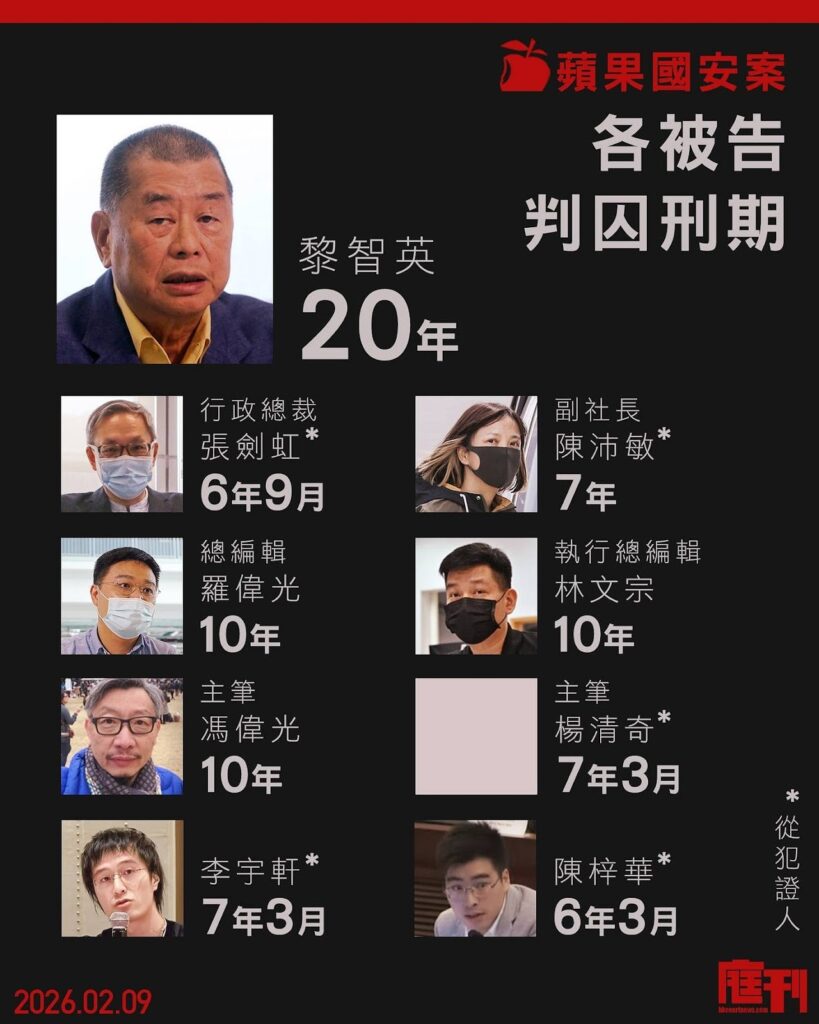
On Monday, Jimmy Lai was sentenced to twenty years for conspiracy to collude with foreign forces and sedition under the National Security Law. Former executives Ryan Law, Lam Man-chung, and Fung Wai-kwong were also sentenced to between six years and three months and ten years. Though I was already pessimistic, the reality was still heartbreaking. That night, walking along the Shing Mun River and listening to podcasts, I thought about how these people have now literally become slaves to freedom.
As I walked, I suddenly realized that a “Slave to Freedom”, translated from 自由的奴隸, could have another, positive interpretation. The status of a “prisoner” is objective and imposed, but the attitude one takes toward misfortune is subjective—an embodiment of personal will. In this interpretation, 自由的奴隸 could be translated as a “Free Slave”.
Understood this way, 自由的奴隸, or Free Slaves, perfectly describes Jimmy Lai, Gwyneth Ho from the 47-person primary case, and Chow Hang-tung, who is still defending herself in her incitement to subversion case. Facing an absurd system, even knowing that a guilty plea or a plea for leniency could reduce their sentences—and in Mr. Lai’s case, knowing he didn’t even have to return to Hong Kong to face trial—they chose to face it bravely. They remained true to themselves from start to finish, upholding their beliefs and manifesting a noble character that pushes free will to its absolute limit.
I have no religious faith, but I believe that even if Jimmy Lai, now seventy-eight, were to pass away in prison, his free soul would live forever in heaven. However, the “heaven” I understand exists within the social conscience.
P.S. Whenever a gross social injustice occurs, I hesitate over whether to comment in this newsletter. The answer is often “no.” Sometimes it’s purely for the sake of “division of labor,” wanting to keep the newsletter focused on my main mission; sometimes it’s because, after stripping away the thoughts that would be illegal to write, there’s nothing left to say. And sometimes—like this time—it’s the belief that everyone already understands, and anything I write would just be repeating what is already known.
However, after being bombarded by the “News Simulcast” over the last few days—with phrases like “deserving of the crime,” “upholding the rule of law,” “justice served,” and even the classic line from From Beijing with Love, “traitor and running dog”—I made a last-minute decision. I cannot forfeit my right to freedom of expression. Even if what I write is merely common sense, in a society where common sense is scarce, it must be written—to add one more record to history.


Leave a Reply