

“Alchemy: The science of understanding, deconstructing, and reconstructing matter. However, it is not an almighty art; it cannot create something from nothing. If you wish to obtain something, you must trade something of equal value. This is the Law of Equivalent Exchange, the foundation of all alchemy. Based on this law, there is a taboo among alchemists: Human Transmutation is strictly forbidden. For what could ever equal the value of a human soul?”
— Fullmetal Alchemist
Equivalent exchange is the most celebrated concept in the world of Fullmetal Alchemist. However, whether it is an unbreakable iron rule is open to debate.
The two protagonists, Edward and Alphonse Elric, broke the taboo by trying to use alchemy to resurrect their mother. As a result, Edward lost his left leg and right arm, while Alphonse lost his entire body. Following the accident, the brothers began searching for the Philosopher’s Stone, believing it could break the Law of Equivalent Exchange and restore their bodies.
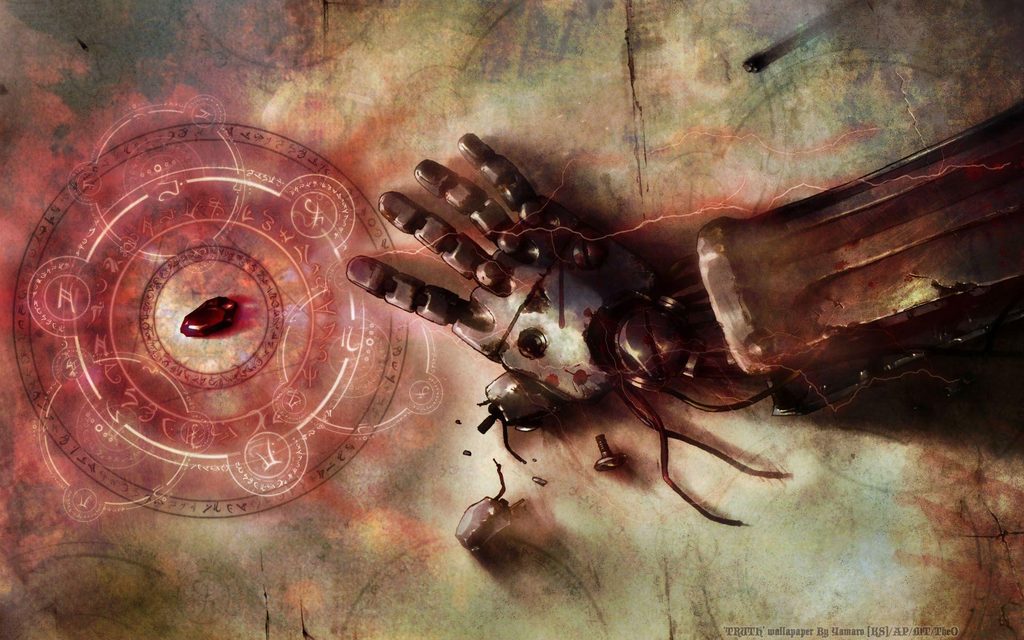
Not long into their journey, the two were shocked to discover that while the Philosopher’s Stone is immensely powerful, it is actually forged from human souls—even a tiny fragment requires countless human lives to create. They later uncovered a massive conspiracy: the entire country had been mapped into a giant transmutation circle, and the main villain, “Father,” planned to sacrifice the entire nation’s population to forge a super Philosopher’s Stone, granting himself powers that transcend humanity, akin to a god.
Does this remind you of Anthropic’s “Project Panama”—scanning and destroying millions of books to train the ultra-powerful large language model Claude? Or of AI giants pouring bottomless resources into developing AGI (Artificial General Intelligence) to surpass humans across the board?
The Philosopher’s Stone and Large Language Models: The Illusion of Cost-Free Creation
In the world of alchemy, holding the Philosopher’s Stone allows one to bypass the Law of Equivalent Exchange. Without setting up transmutation circles or paying a price, one can casually transmute objects or even life itself.
In our world, with AI, humanity seemingly breaks the Law of Equivalent Exchange as well. Without preparing various tools or putting in arduous effort, we can generate articles, images, music, video, and code at the snap of a finger.
As the story unfolds, we learn that the Philosopher’s Stone’s ability to break equivalent exchange is an illusion. In reality, the stone first devoured countless lives before granting the power to transmute things using souls—making it quite literally “blood money” (rénxuè mánmóu).
Similarly, when humans use AI to generate various contents and “creations,” skipping decades of reading and grueling practice, the reality is that AI has preemptively scraped, extracted, and distilled decades or even millennia of human wisdom, creation, and sweat. Every time it generates content, it pays a price in electricity. As OpenAI CEO Sam Altman once joked, users simply adding “Please” and “Thank you” to their prompts costs OpenAI tens of millions of dollars.
In the poll last week asking about AI companies buying up massive amounts of used books to scan and destroy them, the top response (at 36%) was: “Although it’s not illegal, it is utterly despicable on a moral level.” The author notes a similar poll on Threads yielded an even higher 53% for this sentiment.
The Philosopher’s Stone is deeply evil. Since training a large language model is akin to casting a Philosopher’s Stone, calling it “morally despicable” seems logically sound.
Or is it?
The Necessity of Destruction: The Absurd Reality Under Copyright Law
The imagery of books being destroyed genuinely breaks the heart of book lovers. However, before passing harsh judgment, it is best to understand the reasons behind it.
In fact, publishers themselves destroy books quite regularly. Unless they avoid overprinting from the start, once an author’s contract expires, unsold books are often destroyed. Even during an active contract, if inventory piles up and cannot be sold, parts of it may be destroyed to cut warehousing costs.
Copyright essentially revolves around a core principle: the prohibition of unauthorized reproduction. Format shifting was ruled legal in the Bartz v. Anthropic lawsuit, where the court held that owning a book grants the right to digitize it. However, keeping the physical copy after turning it into a digital file means turning one into two—in other words, piracy. While mainstream sentiment views book destruction as “morally despicable,” the fundamental cause driving this phenomenon—aside from AI companies’ needs—is the very copyright law used to protect authors.
On an ethical level, this raises a fascinating yet deeply awkward question: If lawfully destroying books is despicable, would unlawfully keeping the books after scanning them make it acceptable? Or is digitizing a book inherently despicable no matter how it’s done?
Beyond Equivalent Exchange: The Artifact Value of Physical Books and Coexistence with AI
Although I frequently use anime to explain concepts, analogies have boundaries and shouldn’t be swallowed whole.
No matter how similar the Philosopher’s Stone and large language models are, the material of the former consists of irreplaceable, precious lives, while the material of the latter consists of digital content that can be infinitely replicated. AI companies buy used books not to eat the paper, but to legally digitize them as training material.
In other words, if AI companies can reach a consensus with authors and the publishing industry to acquire digital content for machine training fairly, legally, and reasonably, destroying physical books becomes entirely unnecessary.
Returning to the poll, why do so many people feel that destroying books is morally despicable even if they don’t view physical books as sacred objects?
I venture to guess it is because physical books carry both a content attribute and an artifact attribute. Buying a book is one thing, and reading it is often another. Many people buy books without reading them, and many read books without buying them. AI companies only want the content, yet in the process, they destroy physical books that hold commemorative and artifact-like value—and that is what sparks anger.
While I am a function-driven pragmatist, I recognize the value of physical books as artifacts and memorabilia (and am about to publish a hardcover edition of Attack on Freedom limited to just 100 copies). I believe that satisfying the artifact attribute through physical books and satisfying the distribution need through digital formats represents both a path forward for the publishing industry and a way to ease the tension between AI and books.
Large language models are not Philosopher’s Stones. As long as authors maintain a strong enough will to ensure their works are preserved fully, AI doesn’t need the extinction of books as its equivalent exchange.
“If you just receive ten and pass back ten, nothing has changed. So this time, it’s our turn to pass happiness back. If you receive ten, you add your own ‘one’ to it, make it eleven, and pass it on to the next person. It’s a small thing, but it’s the ‘new rule rejecting equivalent exchange’ that we finally managed to come up with!”
— Alphonse Elric
P.S. Contrary to popular stereotype, Hiromu Arakawa, the author of Fullmetal Alchemist, is a woman . When she debuted, she changed a character from her real name Hiromi Arakawa to avoid reader preconceptions about female authors. Born in Hokkaido, she worked on her family’s farm for seven years raising dairy cattle and farming before becoming a manga artist. Known affectionately as “Cow-mama,” her works are filled with deep life experience and humanistic care.
Leave a Reply