
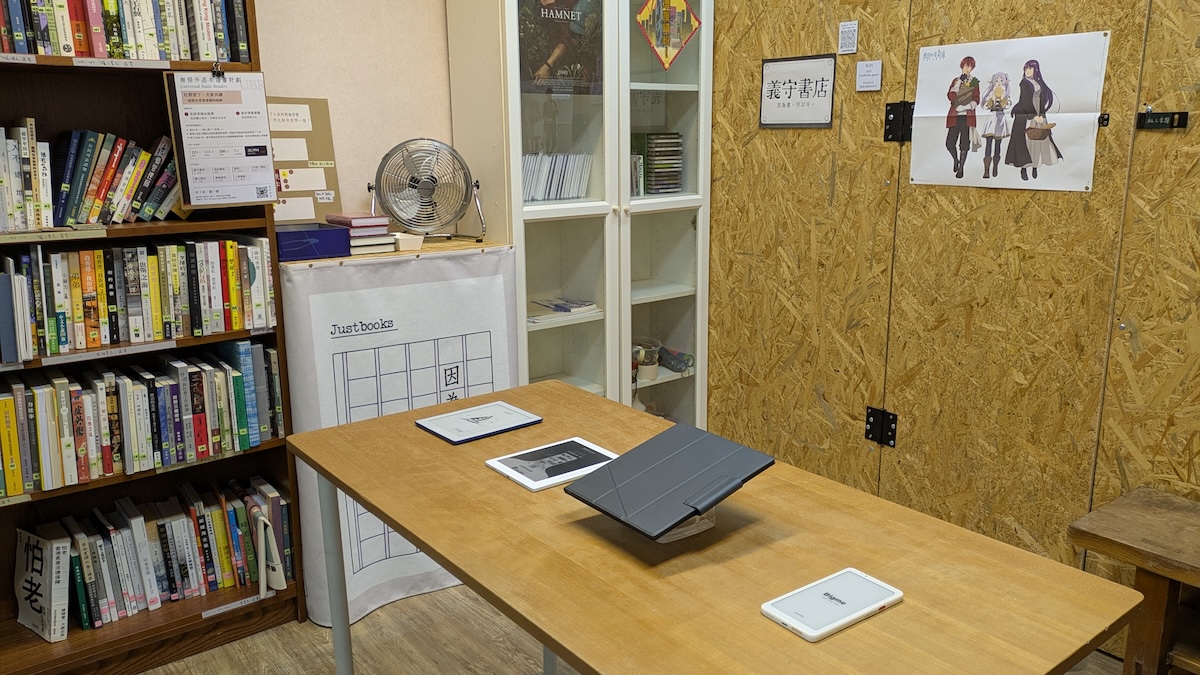
It’s all my fault for always doing bizarre things—I constantly have to spend time explaining to people what I am actually doing. Take Just Books, for example.
Just Books is located directly opposite Sam Kee Book Co., a legendary bookstore famous for its cats in North Point, sharing space operating as “underground bookstores” in the basement arcade. Whenever I talk to people about Just Books being a specialty shop for e-books, they are always thoroughly baffled and ask why e-books shouldn’t just be sold online.
Interestingly, if a physical bookstore builds a website to sell print books, no one finds it strange; in fact, people think it’s perfectly reasonable. Thinking deeper, this is somewhat a double standard. Since print books can also be sold on websites, the question “Why open a physical store?” should logically apply equally to bookstores selling print books.
This is certainly not meant as a provocation. Quite the contrary, I have immense respect for all booksellers who dedicate their time and effort. I just want to explain that although Just Books specializes in e-books and related services, it equally recognizes the value of local, physical connections—motivated much like traditional print bookstores, hoping to use books as a conduit to foster serendipitous encounters and interactions between people.
Choosing e-books wasn’t about being quirky or different; it was a deeply considered decision. Following the social changes of recent years, many people in Hong Kong have realized that our culture must be saved by ourselves, and our history must be written by ourselves. The complete disappearance of websites like Apple Daily, Stand News, and Citizen News led many to lose faith in digital media and turn back to print books. I support any action that safeguards culture, and I support print books and newspapers within my means—such as buying and reading books daily, launching the UBR (“Universal Basic Reader”) initiative, and having independent bookstores collaboratively curate an annual reading list in a decentralized manner. However, while mainstream attention focuses on print, the preservation of content in digital media becomes all the more crucial.
Independent bookstores reflect the book-curation tastes of their owners, often giving off a hipster vibe. What Just Books reflects is a positioning of “Humanism as the core, Technology as the tool.” It mainly centers around e-book services, including selling e-readers, e-book production, as well as digitizing books, newspapers, magazines, optical discs, and film rolls on behalf of customers. Although it calls itself a bookstore, it resembles an “e-book printing factory” or a “copy shop.” I don’t know whether this makes Just Books the least cool independent bookstore around; I only know that someone has to do this.
It is very common for bookstores to also handle publishing. From traditional publishing groups like Commercial Press and Joint Publishing, to recent independent bookstores like Mount Zero (見山), Have-a-nice-stay (留下), Hunter (獵人), and Nowhere (飛地)—besides selling books, they all publish to varying degrees. Just Books is no exception; in fact, one could say publishing is its “primary mission.” The number of books published by Just Books far exceeds the number sold. But unlike traditional publishers who oversee curation, editing, layout design, printing, distribution, and warehousing, Just Books is primarily responsible for scanning materials, creating e-books, and listing them on various platforms.
In 2023, media outlets discovered that public libraries had quietly removed books by Jimmy Lai, Szeto Wah, Zunzi, Au Ka-lun, Benny Tai, Margaret Ng, Roy Kwong, and many others from their shelves. Furthermore, these removals didn’t even exclusively involve political opinions—they included travelogues, commentaries on Jin Yong’s novels, and even romance novels. The exact number of removed titles was unknown, but the civilian reverse-engineered reading list alone exceeded 500 books. Unable to just stand by and watch, I brainlessly (and I mean that in a positive, intuitive sense 🙂 launched the “Hong Kong Decentralized Library” project, aiming to collect and scan removed books, hoping to save as many as possible, one book at a time. The project ran for over a year. At my own expense, I collected over 300 removed books through various channels, alongside more than 700 titles that were very likely to be, or had already been, removed without the public’s knowledge—after all, titles were still being removed from shelves at the time.
Finding these removed books one by one was far from easy, especially out-of-print titles from long ago. But the hardest part was convincing copyright holders to authorize scanning and publishing digital versions. Although the “Hong Kong Decentralized Library” rescued over a thousand books, apart from stuffing my two mini-storage units, there was no avenue to reach the broader public. Making up my mind, I halted the project in September 2024 and launched trial operations for “Just Books” as a consignment cube store in Shatin, managing operations while exploring paths to safeguard Hong Kong’s culture and history.
Around the same period, LikeCoin—which I initiated in 2017 to focus on decentralized publishing—was brewing its v3 DeBook Protocol upgrade. The medium for content preservation transitioned from primarily articles to books, and the accompanying application Liker Land was simultaneously upgraded to 3ook.com (book-dot-com), promoted as a “3rd Generation eBookstore” that is readable, listenable, and ownable. Listing an e-book on 3ook.com is as simple as uploading a video to YouTube. Besides checking whether the uploaded file conforms to EPUB or PDF formats and whether metadata like book title and author are filled out, the system doesn’t make additional judgments on whether the publication is “decent enough.” Even if the cover is a blank piece of paper, the content is only one page, or the illustrations are a child’s scribbles, it won’t be rejected, and the publication is listed immediately.
This isn’t about ignoring editorial quality, but broadening the imagination of what a book can be. Very often, whether a work is considered a book and enters the traditional publishing ecosystem is one thing; whether it is meaningful and worth preserving is another. Community newspapers, which have a small audience but immense significance, are a prime example. Additionally, corporate annual reports, non-profit flyers, theatre house programs, student newspapers, class publications, doujinshi (fanzines), family, or personal zines—all hold meaning for the world, or at least for a segment of people. Yet they are almost never available for purchase or free download in ebookstores. Print must factor in costs like printing, warehousing, logistics, and display, making filtering necessary. But with advanced technology, bandwidth and storage costs are no longer a concern. Even if there are only a few readers, it can still be published. What’s more, viral, blockbuster content often originates from unintentional, casual creations.
3ook.com can be thought of as the “YouTube for printed matter.” On one hand, it provides entry points via smartphone, tablet, and computer applications for readers to discover, purchase, and borrow various e-books, newspapers, and magazines anytime, anywhere. On the other hand, it drastically lowers the barrier to digital publishing, empowering grassroots creators, documentarians, and reporters so that every tiny piece of history can be seen.
That said, even though smartphones have made taking photos and recording video basic skills, no matter how simple e-book creation is, there are still technical skills to master. There is a vast amount of content in society worth preserving; even if copyright holders are willing to digitize and preserve it, they may lack the resources, ability, or may even no longer be alive—requiring someone else to step in.
To readers, 3ook.com is an online bookstore, while Just Books is a physical bookstore. To me, both are actually continuations of the Hong Kong Decentralized Library: the former is an open infrastructure where anyone can publish, and the latter is an e-book “printing plant” that digitizes physical books. Without 3ook.com, the ebooks produced by Just Books would have no suitable home; without Just Books, 3ook.com would just be a cold, empty bookshelf—code alone cannot proactively bring out-of-print Hong Kong books, canceled event programs, and various historical materials scattered among the public directly to readers.
After Just Books’s publishing work got underway, classical works like Outcry(吶喊) and Selected Prose of Xu Zhimo(徐志摩散文集) led the way, aimed at streamlining processes and improving tools through public domain books. Once preparations were complete, starting last year, Just Books reached out to publishers and independent authors everywhere. To encourage content preservation, whether for new releases or past works, ebooks were produced without upfront fees. Depending on the publisher’s preference, Just Books sometimes served as distributor, and other times publishers or authors uploaded the books themselves—the sole goal being to provide the missing puzzle piece in the decentralized publishing ecosystem. By early 2026, content preservation efforts had achieved modest success, with over 100 participating titles.
Among all the projects, the collaboration with Progressing Media (進一步多媒體) and InMedia (獨立媒體) came closest to the original intention of the “Hong Kong Decentralized Library” three years ago. The works of both organizations are crucial records of the era, yet most are completely out of print, and all have either been removed from public libraries or were never stocked in the first place—making them precisely the kinds of works civilian historical preservation should focus on most. In light of this, Just Books scanned six older works from InMedia, such as Our Umbrella Era — Umbrella Timeline and Media Operations and Citizens of a Kind — Chroniclers Traveling between City and Countryside, as well as works from Progressing Media such as Walter Benjamin on Violence and Return Power to the People: Democracy, Elections, and Resistance, making them available one by one on 3ook.com for everyone to purchase or borrow.
Although Just Books operates commercially and is “a business,” in reality, like many independent bookstores, it is powered by love, paying out of pocket to do what is supposed to be handled by the government. Beyond extremely tight finances, experiences since 2019 have continually shown me that a greater obstacle to grassroots historical preservation is copyright holders refusing authorization due to commercial considerations or political concerns, preferring that their works remain hidden away forever. I absolutely agree that creative work has value, and I respect others’ right to be forgotten; however, standing from the perspective of a documentarian, feeling upset about this is inevitable.
Even so, Just Books only knows how to press on for as long as it can, taking its positioning as an ebook specialty shop to fulfill its mission of preserving culture and safeguarding history. Just defend it.
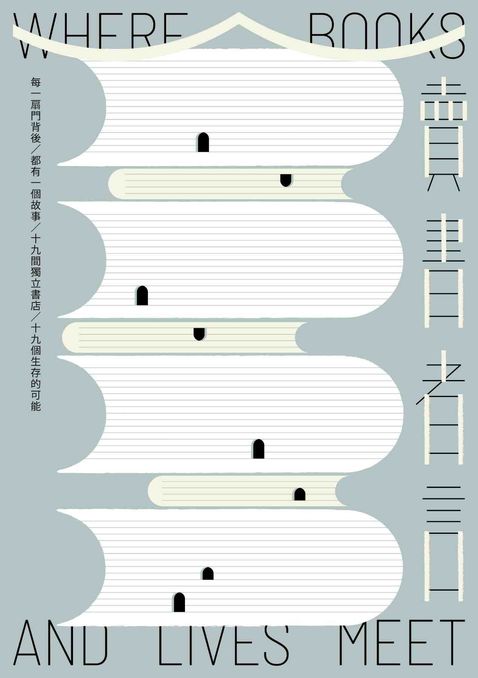
《賣書者言》:森記、塔冷通、序言、艺鵠、Seeds、見山、一拳、南灣、神話、渡日、留下、獵人、界限、長夢、渴喝、飛雲、義守、種種、碼頭,19 家獨立書店的故事。
p.s. Just Books is currently undergoing minor renovations. The shop area will expand from 10 square meters to 16 square meters—mathematically an expansion of operations by 60%! Hope to offer enough space for everyone to try out e-readers and experience the 3ook.com library.
Leave a Reply