
cover image by kwanyi
When discussing libraries, most people immediately think of public or national libraries, followed by university and secondary school libraries. Additionally, certain organizations—such as theological seminaries or professional guilds—operate small libraries to house books on specific themes. However, we almost never hear of independent, citizen-run libraries.
Almost every country has private schools, yet few have private libraries of any significant scale. The reason is incredibly simple: education can be highly profitable, but a library is destined to be a money-burning machine. Parents are willing to pay astronomical fees to enroll their children in international schools, and universities like Harvard, Stanford, Waseda, and INSEAD are not only massive businesses but also sit on enormous alumni donations. But what about libraries? No one denies their value, yet very few people actually use their services, and even fewer are willing to pay for them—overdue fines notwithstanding. But that is not entirely fair either; after all, public libraries are operated using taxpayers’ money, whether or not those citizens agree with how the funds are used or are satisfied with the book selection.
Therefore, before discussing the ideal qualities of an independent library, it must first possess a sustainable business model. The newly launched 3ook.com library is working hard to make this possibility a reality, as far as ebooks are concerned.
Distributed Funders: Protecting Independence with a Business Model
The moment money is mentioned, things often seem to lose their purity, as if turning into a mere “business.” In reality, the essence has not changed; what has changed is our need to face reality. Libraries have always required substantial resources to operate—the only difference is who pays for them. As someone who makes personal works fully open-licensed and is often viewed as an “idealist” (aka leftard?), I probably have the credentials to say that I wish citizen libraries could be free for everyone. However, only by not relying on government funding or single-organization backing (like family foundations), and instead relying on citizens pooling their resources, can a library remain independent and survive long-term.
Furthermore, when talking about business models, we must look beyond downstream readers and consider upstream suppliers: publishers and authors. As sacred as traditional libraries are, they have a delicate, love-hate relationship with publishers. On one hand, libraries provide a baseline of guaranteed book purchases—especially for serious literature—and foster a long-term reading culture. On the other hand, some industry insiders worry that libraries reduce people’s desire to buy books. Even if a book is borrowed extensively, the publisher only receives a single royalty payment from the initial sale.
In other words, even if an independent library has the financial capacity to be completely free for readers, a lack of stable revenue streams means it is just being generous at others’ expense. It fails to bring publishers any source of income beyond baseline royalties. If that source runs dry, there will eventually be no new books. Therefore, I chose a monthly subscription model for 3ook.com, preferring to find alternative ways later to subsidize the minority of readers who cannot afford the fee.
Putting aside philosophical debates, 3ook.com’s business model is incredibly simple. In one sentence: it is a “Netflix of books”—one monthly fee for unlimited reading and listening.
Netflix of Books: Flat Monthly Fee
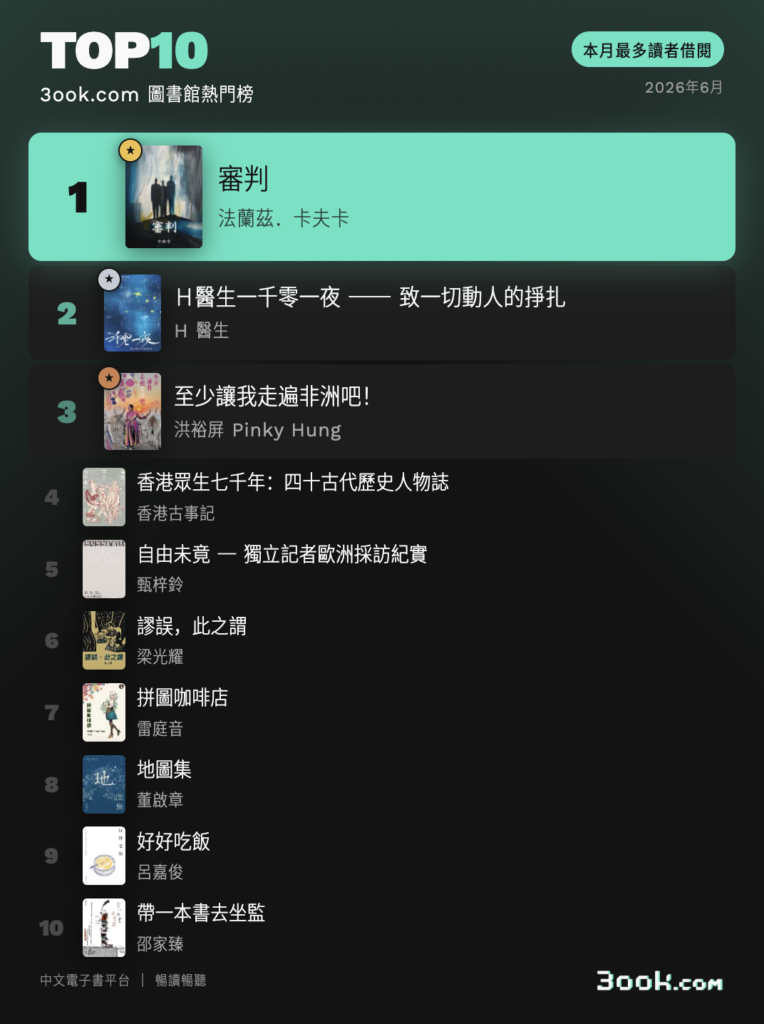
3ook.com is still in its infancy. It currently features a curated selection of over 600 books. Numerically, this is a drop in the bucket compared to public libraries, but there is very little overlap between the two collections, meaning 3ook.com supplements public libraries with a citizen-curated perspective.
Becoming a Plus Member costs 9.9 USD (78 HKD / 300 TWD) per month. In addition to borrowing any book in the collection, users can choose to listen to books instead of reading them, provided the publisher has enabled the read-aloud option.
The phrase “one monthly fee, unlimited reading and listening” is literal: 3ook.com does not split ebooks and audiobooks. By obtaining voice actor licenses beforehand and utilizing AI to analyze voice prints, the system reads the text aloud in real-time when a reader listens. This gives a voice to every book, making it both readable and listenable.
For upstream publishers and authors, the 3ook.com model is equally straightforward. As long as the work uses standard EPUB or PDF formats and complies with local laws, creators can upload their books themselves and choose whether to enable the narration feature. If technical support is needed, the library even offers peripheral services like text scanning and digital file creation.
Whenever a reader reads or listens to a work for 1 minute, the author or publisher receives 0.01 USD, settled monthly. For example, if a reader borrows a book and spends 10 hours reading and listening to it from cover to cover, the publisher or author receives:
0.01 USD × 60 × 10 = 6.00 USD
This relatively high payout rate relies on a shared community effort. The heavy reading habits of power users are supported by the unused capacity of light readers, creating a dynamic balance between overall library operations and creator earnings.
Starting with a Strong Foundation
Admittedly, while this business model is simple, it may not perfectly address every scenario.
The most obvious issue is usage variation. A reader who doesn’t open a single book all month, a reader who reads only on weekends, and a reader who listens during their daily commute all pay the exact same monthly fee. Will low-usage readers accept this? On the scarcer side of demand, there are also people who wish to pay more to support publishing, but that option does not currently exist.
On the publisher side, there are also various concerns. For instance, is it fair that high-priced and low-priced books generate the exact same income per minute of reading? Picture books require immense effort per page but can be read very quickly; is a time-based payout model too low for them? Conversely, is the payout too high for public-domain classics and out-of-copyright works when compared to contemporary books?
These are all valid, real-world scenarios that the current model may not perfectly satisfy. However, in the library’s startup phase, a flat subscription fee and a flat payout structure help build consensus. It maps out typical use cases and establishes a “basic foundation” first, leaving edge cases for later. Once we achieve results and accumulate a solid collection of quality books, readers, and reading hours, we will have the confidence to negotiate long-term plans with all stakeholders, allowing a wider variety of books to enrich this citizen library.
Running an independent library is no easy task. The road ahead is bound to be filled with obstacles. Alongside the challenges we already foresee, countless unknown hurdles will undoubtedly follow. Since we cannot predict the outcome, we might as well focus on the present and do what we can and should do.
After two years of preparation, the 3ook.com library is officially launched, supporting iPhone, Android, iPad, macOS, and web browsers. If you believe in the meaning of this project, please install it and try it out, at least to experience it.
If you have a little to spare, I hope you will go one step further and become a Plus Member. Enjoy unlimited borrowing, distribute your monthly fee directly to authors as you read, and support the operation of this independent citizen library.
Become a Plus Member to support the independent library
P.S. The annual Hong Kong Book Fair starts today. I really wanted to go to visit the booths of Futubull, Tiger Brokers, the Food and Environmental Hygiene Department, the Lands Department, the Geotechnical Engineering Office, the Construction Industry Zero Carbon Park, the Jockey Club End-of-Life Care in Hong Kong Project, and the Silent Teacher Body Donation Program. Plus, a single ticket also grants access to the co-located Hong Kong Sports and Leisure Expo and World of Snacks. Many thanks to the Trade Development Council for organizing such a diversified Book Fair.
Leave a Reply